Thursday, February 17, 2011
Cultural Notes: Definitions of Beauty
When it comes to ideas of beauty, the 19th century Europeans and the 19th century Chinese appear to have nothing in common. In the West, petticoats, hoop skirts, and corsets were the fashion. In the Far East, women might wear shirts and trousers, and feet were often bound.
There is, however, a correlation. Corsets and hoops may seem completely different from three-inch feet, but they are similar--they drastically distort the female figure.
Let's start with the corsets of the West. It was popular to have a small (and I mean small) waist, and corsets played a big part in achieving the look. Corsets were laced tightly, and years of wearing them could make a woman's waist smaller. It was unhealthy--internal organs would be pushed together by the continuous strain. It was painful, too.
The women of the West also had hoop skirts and petticoats, masking the entire lower halves of their bodies. It also made the waist appear even smaller than it already was, just by giving it something to be compared to.
So, those ladies had some serious distortion going on, both physically and aesthetically. What about the women in China?
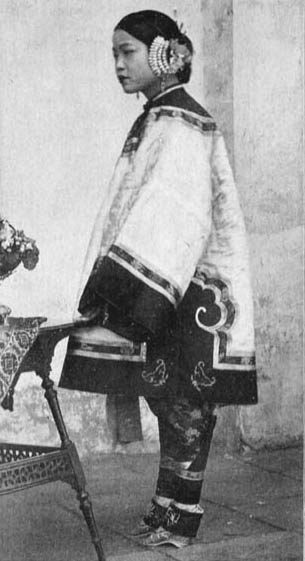
Small feet were common in China in the 19th century, and certainly fashionable. A big part of beauty was the size of a woman's feet. For most people, however, you weren't just born with tiny feet. How to achieve the look, then?
Foot-binding was the solution for a lot of girls. Like corsets, binding would make feet smaller and smaller. To get three-inch feet, bones would have to be broken often, and it was a painful process for years on end. (Sadly, this was a lot harder to ignore with bound feet than with corsets.) However, there was a light at the end of the tunnel--a woman would be a lot more likely to be married into a richer household if she had bound feet.
I found it interesting that, despite the horror expressed at foot-binding (it always manages to get mentioned in articles on 19th century China), many people will scarcely glance at corsets for a lot of the time, let alone their painful and hazardous repercussions.
If I do say so myself, the vanity of corsets disgusts me. I don't have much of a problem with hoops, and even less with petticoats, but that a woman would hurt herself so much purely for the sake of fashion makes me nauseous. Foot-binding was a painful and dangerous process, but there was a sort of necessity to it. Corsets have no such excuse.
But that's my rant. :)
Anyway, the correlation is interesting to me.
What to Do When 2012 Comes?
I was wondering what to do on the 21 of December next year. After all, it's not that far away. Why not start making plans now?
Mind you, I'm not into the "world's gonna end"/"humanity's gonna end"/"we're going to another dimension" stuff. I'm just in the mood for celebration.
Here are some ideas to throw around:
Just some food for thought about the winter solstice two years from now.
Mind you, I'm not into the "world's gonna end"/"humanity's gonna end"/"we're going to another dimension" stuff. I'm just in the mood for celebration.
Here are some ideas to throw around:
- If you live in a place that, say, won't sink into the ocean, throw a party and invite friends/family who are worried about it (and are worried about their own safety). It can be overnight, or maybe some (or all) guests can stay for the holidays.
- If you're a geeky Legend of Zelda fan, you can play the Oath to Order or Song of Healing from Majora's Mask. (Or the Song of Time, if you're not into saving/healing the world....)
- Do something special that marks the restarting of the calendar. It might be religious, cultural, or maybe something that has special significance to you.
- You might not want to be out and about in a large city-- a lot of people are expecting something drastically big (and bad) to happen, and some people might freak out come the solstice.
Just some food for thought about the winter solstice two years from now.
Monday, February 14, 2011
Victorian Reconstructionism
There are certain things about the Victorian era that I love. They aren't very related to each other: bonnets, mourning, and artistic dress are the biggies at the moment.
There are also things about the era that I hate, corsets being one of them. It also frustrates me when things from different decades, which would go quite well together, must remain separated in order to be historically correct.
So, why remain historically correct?
I informally coined the term "Victorian Reconstructionism" to refer to modern interpretations of the Victorian culture and the sub- and countercultures that came with it. It doesn't require complete historical accuracy. You could wear a skirt, a sweater, and a Victorian-esque bonnet. Alternatively, you could wear black to varying degrees to honor a loved one. You could even mix different styles and different periods.
There is a style that would be considered Victorian Reconstructionist. It's called Lolita fashion, and incorporates petticoats and blouses, as well as other Victorian fashion elements. The skirts are approximately knee-length (longer or shorter, depending on the sub-style), a nod to younger girls' clothing. The style also has modern elements to it, such as certain prints on the skirts/dresses. (Think music notes, crosses, and fairy tale scenes.)
However, this style is specifically based on children's clothing, and is purely a fashion--cultural aspects are almost all lost, except for "lifestyle Lolitas" who practice traditional arts and crafts. Therefore, those wishing to take on certain Victorian customs without dressing up might not like it.
Victorian Reconstructionism is a very loose term, and can mean anything from dressing traditionally to having 19th-century manners. It is meant as a much-encompassing term.
Oh, and for any Lolitas who might have been offended by my review of the Lolita fashion, I'd like to note that I am a part-time Loli who loves the fashion.
There are also things about the era that I hate, corsets being one of them. It also frustrates me when things from different decades, which would go quite well together, must remain separated in order to be historically correct.
So, why remain historically correct?
I informally coined the term "Victorian Reconstructionism" to refer to modern interpretations of the Victorian culture and the sub- and countercultures that came with it. It doesn't require complete historical accuracy. You could wear a skirt, a sweater, and a Victorian-esque bonnet. Alternatively, you could wear black to varying degrees to honor a loved one. You could even mix different styles and different periods.
There is a style that would be considered Victorian Reconstructionist. It's called Lolita fashion, and incorporates petticoats and blouses, as well as other Victorian fashion elements. The skirts are approximately knee-length (longer or shorter, depending on the sub-style), a nod to younger girls' clothing. The style also has modern elements to it, such as certain prints on the skirts/dresses. (Think music notes, crosses, and fairy tale scenes.)
However, this style is specifically based on children's clothing, and is purely a fashion--cultural aspects are almost all lost, except for "lifestyle Lolitas" who practice traditional arts and crafts. Therefore, those wishing to take on certain Victorian customs without dressing up might not like it.
Victorian Reconstructionism is a very loose term, and can mean anything from dressing traditionally to having 19th-century manners. It is meant as a much-encompassing term.
Oh, and for any Lolitas who might have been offended by my review of the Lolita fashion, I'd like to note that I am a part-time Loli who loves the fashion.
Tuesday, February 1, 2011
Hello to the World
Hello.
My name is Elilura. I've wandered from place to metaphorical place, knocking on metaphorical doors and hoping to find a home. Because of this, I've become even less conforming to any society than I used to be. I now wear a variety of clothing, borrowing from many groups. I swing from religion to religion every few months-- studying the Torah on Saturdays, but cooking magically a few days a week. (Notice the juxtaposition of "months" and "days"--more on that in a later post.)
I may be my own person with my own style, but I still knock on doors. I haven't stopped searching for "my people", and I don't expect to find a subculture that I completely conform to. However, I think these wanderings are giving me a variety of experiences. That, I think, is a good thing, which will help me through life. (Ah, who am I kidding--it already is!)
This is a chronicle of my wanderings through fashion, religion, and culture.
My name is Elilura. I've wandered from place to metaphorical place, knocking on metaphorical doors and hoping to find a home. Because of this, I've become even less conforming to any society than I used to be. I now wear a variety of clothing, borrowing from many groups. I swing from religion to religion every few months-- studying the Torah on Saturdays, but cooking magically a few days a week. (Notice the juxtaposition of "months" and "days"--more on that in a later post.)
I may be my own person with my own style, but I still knock on doors. I haven't stopped searching for "my people", and I don't expect to find a subculture that I completely conform to. However, I think these wanderings are giving me a variety of experiences. That, I think, is a good thing, which will help me through life. (Ah, who am I kidding--it already is!)
This is a chronicle of my wanderings through fashion, religion, and culture.
Subscribe to:
Posts (Atom)